The history of microbiology contains several eras with different targets. I will refer them in this way (based on my over 30 years experience as microbiologist and teacher of microbiology and biochemistry):
In the beginning, cultivation and observation of microorganisms was the main target. Doctors like Pasteur and Koch were very innovative and developed intelligent culture medias and vessels to perform very delicate experiments. The everlasting fight against pathogenic microbes was the primary target but Louis Pasteur started to help eg. wine producers to solve their quality problems, caused by microbes.
The combination of microbiology and biochemistry on the second era was very satisfying by solving questions concerning the huge amount of anabolic and catabolic processes included in microbial growth. More and more were also learned in the area of microbial ecology. Questions like "who? what? when? where? how? why?" were partially solved (ref. MADSEN,E.L. 2008. Environmental Microbiology. From Genomes to biochemistry. Blackwell Publishing).
"Third era" can be described by the novel methods to identify bacteria. Biochemical test kits (API etc.) were replaced by Fatty Acide Methylated Ester method (FAME) by Hewlett-Packard on 80's. After it, molecular biology methods, based on ribosomal RNA and DNA, helped to construct the development lines of microorganisms.
Today is the time of new era. We know the "family trees" of bacteria but we should now continue with environmental microbiology and microbial ecology to solve questions like "How, why, by whom and in which conditions will the raw materials of paper industry be biodeteriorated?", "How can we prevent these processes by setting the process conditions unsuitable for those biochemical processes?", "Can we prevent the growth of biofilms and slimes in an ecological way?", "How to prevent selectively the growth of toxin producers like Bacillus cereus in paper and board processes?", how to fight against Legionella in paper industry?".
Names are not the most important thing. Most important is, how the bacteria act in different ecological niches of a paper machine. This work has to be done by using simulations of paper processes which is possible by wet end simulators of research units (as an example: VTT in Jyväskylä, Finland) and laboratory/field instruments (like biofilm detectors in the processes or PMEU incubators by Samplion Ltd.).
The role of PMEU is getting more and more important because this method helps to detect microbial growth of different types (biofilms included) in a very short period of time as well as to test simultaneously the effects of alternative biocides in small-scale tests whose growth parameters match with the growth conditions in the real processes.
We are - and we shall - turn back to the era of Pasteur & Koch: the names are already known, and we shall now investigate, what the contaminating microbes are doing in the industrial processes and how to prevent losses of raw material, machine stops and poor quality of the products by simulating growth processes in small-scale tests, performed in the laboratory or in the field, by the machies themselves.
Sunday, April 25, 2010

Saturday, March 27, 2010
PMEU applications for water hygiene analyses have been published in "Rakennustarkastuspäivät 2010"
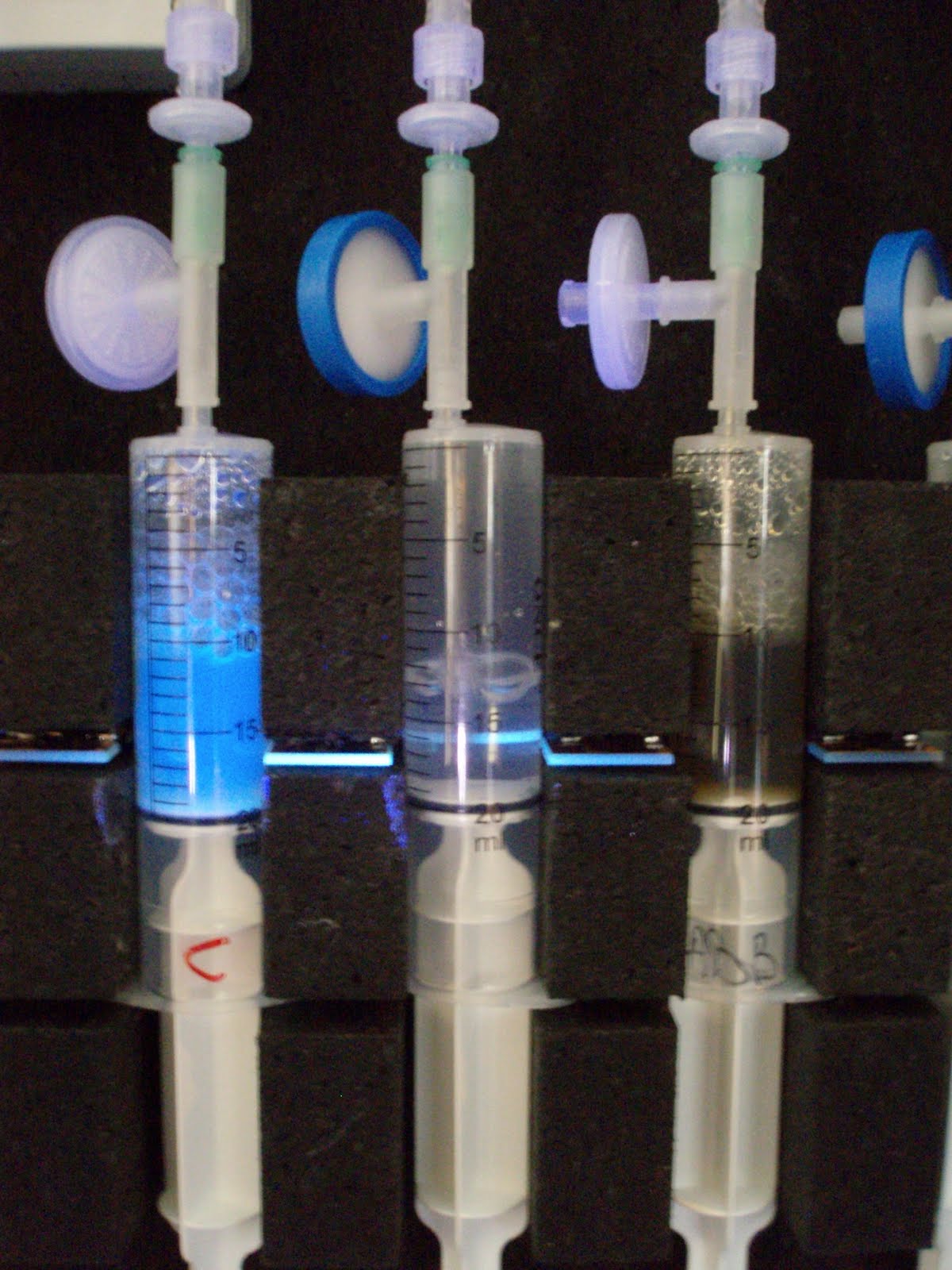
Novel PMEU water hygiene analyses, intended in the quantitative control of total coliforms, E.coli and enterococci, have been published in "Rakennustarkastuspäivät 2010" Conference, Kuopio, Finland at the end of March. This annual event is dedicated to professionals of building regulations and related administration and collected over 200 participants to the beutiful capital of Savo region, in the middle of Saimaa lake district.
SAMPLION Ltd. was exhibiting PMEU Spectrion and its water hygiene applications, now qualified by VTT, alongside Suomen Jätevesi Ltd. which is the major supplier of small-scale waste water purification systems in Finland.
The picture above demonstrates the combination of selective growth medium and MUG-based UV fluorescence confirmation of E.coli. Among the three PMEU syringes, only the one on the left, containing a culture of E.coli, indicates this fluorescence. This PMEU method is now approved by VTT, Technical Research Centre of Finland (VTT-S-01705-10) and it also follows the guidelines of international standardization (SFS-EN ISO 9308-3) to fulfill the needs of rapid, quantitative control of hygiene indicator bacteria.
Wednesday, March 3, 2010
Detection Time as the Variable in Quantitative Microbe Analyses

There are several methods to quantify the count of microbes. Historically the very first of them (if microscopy is excluded) was the use of dilutions series in nutrient broths. This methods was later developed to MPN (Most Probable Number) Method, which was the standard until the rise of Colony Count methods. Colony counts give accurate numbers but suffer of the poorer recovery of the microbial cells, compared to the broth methods. It is also unavailable for certain, difficult types of samples.
"Third Generation" of quantitative mb analyses was established some 30 years ago. They are based on analytical methods which give the results much faster than the traditional methods by measuring some chemical or physical features of the samples which are in a relationship with the count (or activity) of microbes of the original samples.
The increase of the nutrient broth turbidity, caused by the growth of microorganisms, is maybe the most common "3rd Generation" method used today. It is an optical method which gives levels of either total growth or specified microbes (in latter case, selective broths with confirmation tests are applied). An inversed corretation between microbial load and detection time (= the moment of the testing period when turbidity begins to rise) can be found and correlation lines/tables between colony counts and detection times are easy to construct.
The figure above is an example of the growth curves, derived by PMEU Spectrion. X axis shows the time scale of the test, y axis indicates the values of RT. This curve shows that PMEU Spectrion actually illustrates the classic growth curves with the lag, log and stat phases (and, if the cultivation will continue long enough, also the kill phase). The moment when the turbidity begins to rise is inversely related to the count of microbes in the original sample.
Tuesday, January 12, 2010
SAMPLION Ltd. in Finnish Medicine Congress, Helsinki, January 11.-14.2010

PMEU Spectrion is one of the microbiological analyse devices manufactured by SAMPLION Ltd. It represents a modification of the basic PMEU where the turbidity of the samples, correlating with the microbial growth inside the test syringes, will be automatically measured with LED detection.
Beside the PMEU Spectrion, results of some hospital projects were also presented in the form of a poster.
Sunday, January 3, 2010
Use of portable enrichment unit in rapid characterization of infantile intestinal enterobacterial microbiota
Jouni Pesola1,2, Outi Vaarala3, Anneli Heitto4 & Elias Hakalehto4,5
Institute of Clinical Medicine, Pediatrics, University of Kuopio, Kuopio
Department of Pediatrics, Kuopio University Hospital, Kuopio
National Institute for Health and Welfare, Helsinki
Department of Biosciences, University of Kuopio, Kuopio
Finnoflag Oy, Kuopio and Siilinjärvi, Finland
Correspondence: Jouni Pesola, Department of Pediatrics, Kuopio University Hospital, POB 1777, FI-70211 Kuopio, Finland. E-mail: jouni.pesola@kuh.fi
Abstract
Objective: The aim of this study was to develop a practical and efficient method for isolation and characterization of the enterobacterial microbiota of infant fecal samples. It could be used for reliable comparisons between individual microflora in different neonates, and in the follow-up of the succession in the floral developments in various nutritional conditions. Methods: A combination of traditional plate culture and different enrichment procedures carried out in a portable microbe enrichment unit (PMEU) was studied. The strains were isolated by plate culture both before and after enrichment. The isolated strains were identified by biochemical tests and the phenotypes of the isolates were compared by the PhenePlate™ technique. To obtain a picture of the formation of intestinal flora during the first year two follow-up samples were collected at the ages of 3 and 12 months from eight Finnish infants (one girl and seven boys). Results: Altogether 21 and 46 enterobacterial isolates were detected in samples taken at the ages of 3 and 12 months, respectively; 7/21 (33%) and 24/46 (52%) isolates were not detected by direct plating but only after enrichment. This material was supposed to demonstrate the differences between the different methodological approaches. Conclusion: There were age-dependent changes in the species proportions of different subpopulations of Enterobacteriaceae detected from the infantile fecal microbiota at different times. The statistically significant difference in the number of isolations with and without enrichment step suggests that the use of enrichment is highly recommendable and the PMEU equipment and method have now proven suitable for that purpose, at least for screening and monitoring the infant fecal flora. The method offers more representative, quicker, and relatively practical tools for obtaining an overall picture of the enterobacterial microbiota of the fecal samples and its variations, thus also giving an idea of the microbial communities in the gastrointestinal tract.
Institute of Clinical Medicine, Pediatrics, University of Kuopio, Kuopio
Department of Pediatrics, Kuopio University Hospital, Kuopio
National Institute for Health and Welfare, Helsinki
Department of Biosciences, University of Kuopio, Kuopio
Finnoflag Oy, Kuopio and Siilinjärvi, Finland
Correspondence: Jouni Pesola, Department of Pediatrics, Kuopio University Hospital, POB 1777, FI-70211 Kuopio, Finland. E-mail: jouni.pesola@kuh.fi
Abstract
Objective: The aim of this study was to develop a practical and efficient method for isolation and characterization of the enterobacterial microbiota of infant fecal samples. It could be used for reliable comparisons between individual microflora in different neonates, and in the follow-up of the succession in the floral developments in various nutritional conditions. Methods: A combination of traditional plate culture and different enrichment procedures carried out in a portable microbe enrichment unit (PMEU) was studied. The strains were isolated by plate culture both before and after enrichment. The isolated strains were identified by biochemical tests and the phenotypes of the isolates were compared by the PhenePlate™ technique. To obtain a picture of the formation of intestinal flora during the first year two follow-up samples were collected at the ages of 3 and 12 months from eight Finnish infants (one girl and seven boys). Results: Altogether 21 and 46 enterobacterial isolates were detected in samples taken at the ages of 3 and 12 months, respectively; 7/21 (33%) and 24/46 (52%) isolates were not detected by direct plating but only after enrichment. This material was supposed to demonstrate the differences between the different methodological approaches. Conclusion: There were age-dependent changes in the species proportions of different subpopulations of Enterobacteriaceae detected from the infantile fecal microbiota at different times. The statistically significant difference in the number of isolations with and without enrichment step suggests that the use of enrichment is highly recommendable and the PMEU equipment and method have now proven suitable for that purpose, at least for screening and monitoring the infant fecal flora. The method offers more representative, quicker, and relatively practical tools for obtaining an overall picture of the enterobacterial microbiota of the fecal samples and its variations, thus also giving an idea of the microbial communities in the gastrointestinal tract.
Sunday, December 13, 2009
Fast detection of bacterial growth by using Portable Microbe Enrichment Unit (PMEU) and ChemPro100i® Gas Sensor.
The series of scientific articles, based on the microbiological research beneficing PMEU methods, continues. The new model of PMEU, "Scentrion", measures the gaseous metabolites, derived from the microbial activity in the sample syringes, and gives therefore the fastest indication of very low contamination levels in only 2..3 hours. PMEU Scentrion is already applied in a Finnish hospital laboratory. It is one of the new PMEU innovations, presented in a short R&D period in 2009 (another is PMEU "Spectrion" where the detection of the microbial growth bases on automatic turbidity measurement - more about it in future posts of this blog).
A short notification of this article follows below (to have more detailled view into the method and results derived with it, please refer the original article, published in June 2009 by Pathophysiology):
"E. Hakalehto, J. Pesola, A. Heitto, B. Bhanj Deo, K. Rissanen, U. Sankilampi, T. Humppi, H. Paakkanen.
Fast Detection of Bacterial Growth by using Portable Microbe Enrichment Unit (PMEU) and ChemPro100i® Gas Sensor.
Pathophysiology 16:1 (2009) 57-62.
PMEU Scentrion gives results in a few hours from the cultures, starting from only single cells per ml to a few hundreds of cells per ml. It is therefore a clear improvement to even PCR methods, which normally require an overnight pre-enrichment to be practically sensitive enough."
A short notification of this article follows below (to have more detailled view into the method and results derived with it, please refer the original article, published in June 2009 by Pathophysiology):
"E. Hakalehto, J. Pesola, A. Heitto, B. Bhanj Deo, K. Rissanen, U. Sankilampi, T. Humppi, H. Paakkanen.
Fast Detection of Bacterial Growth by using Portable Microbe Enrichment Unit (PMEU) and ChemPro100i® Gas Sensor.
Pathophysiology 16:1 (2009) 57-62.
PMEU Scentrion gives results in a few hours from the cultures, starting from only single cells per ml to a few hundreds of cells per ml. It is therefore a clear improvement to even PCR methods, which normally require an overnight pre-enrichment to be practically sensitive enough."
Sunday, November 22, 2009
A novel training course of the PMEU enrichment and the microscopy of enriched samples in March, 2010.
The microbiological microscopy courses by FINN-FIBER Ltd. have been very popular ones over years. Participants of this annual course learn the basics of light and UV epifluorescence microscopy, isolate microbes from the samples and document the results with digital microphotography into the form of PowerPoint reports.
A novel course, containing PMEU enrichments in the beginning of this 3-day course, is under planning on these days. Four teachers - every one is a specialist on her/his area of microbiology - will combine their efforts to cover a wide range of bacteria and moulds as the subjects of the enrichments, isolations and microscopic examinations.
The course will be held in Jyväskylä, Central Finland, in March 2010. More information follows soon.
A novel course, containing PMEU enrichments in the beginning of this 3-day course, is under planning on these days. Four teachers - every one is a specialist on her/his area of microbiology - will combine their efforts to cover a wide range of bacteria and moulds as the subjects of the enrichments, isolations and microscopic examinations.
The course will be held in Jyväskylä, Central Finland, in March 2010. More information follows soon.
Subscribe to:
Posts (Atom)

