Elias Hakalehto, Doc., Ph.D.
Department of Biosciences
University of Eastern Finland
P.O.B. 1627
FI-70211 Kuopio
Finland
Abstract, 41st R3-Symposium of the R3-Nordic Society in Espoo 25.-26.5.2010
The PMEU (Portable Microbe Enrichment Unit) technology (Samplion Oy, Siilinjärvi, Finland) is a microbe cultivation method producing advantageous growth conditions for individual bacterial cells. Therefore, monitoring of bacterial populations and the presence of potential contaminants is optimised in terms of speed and accuracy. Hygienically important isolates of various bacterial strains have been cultivated aerobically, microaerobically or anaerobically using standard broth media by standard PMEU enhanced enrichment technology, or by PMEU Spectrion ® or PMEU Scentrion ® sensored units equipped with optical, IR, or gas sensors. The units were produced by Samplion Oy according to the ISO 9001 accepted protocol. The reference cultivations were carried out using standard microbiological procedures. The PMEU Spectrion ® is being validated by the VTT of Finland. PMEU versions facilitated ultra-fast detection of coliformic bacteria, bacilli, salmonellas, staphylococci, streptococci, campylobacteria and other groups. The PMEU Scentrion ® equipped with gas sensors for volatile organic compounds detected the contaminants at concentrations of bacterial levels around 10-1000 cfu/ml in 2-5 hours. Also the hospital validation studies in Austria and Finland are summarized. Moreover, The PMEU has been demonstrated to help the environmentally stressed cells to recover and become viable in the enrichment cultures. Hygiene sampling was carried out using a specific sampling syringe serving also as an incubator in the PMEU.
Showing posts with label SAMPLION Ltd.. Show all posts
Showing posts with label SAMPLION Ltd.. Show all posts
Thursday, June 24, 2010

Tuesday, June 15, 2010
Biocide testing with PMEU Spectrion has begun!

PMEU biocide testing has been available already since the early years of this millenium. This method is based on Basic PMEU and ATP Assay. This combination gives reliable results and has been presented in several articles (last time in Paper and Timber, Nov. 2009).
First, very promising tests with PMEU Spectrion have now started, both in laboratory and in the mills. The picture above shows a typical equipment for mill trials, containing both PMEU Spectrion and ATP Assay tests. PMEU Spectrion measures growth curves of the microbial population (total or selective) automatically and is therefore independent of ATP Assay.
SAMPLION Ltd. will focus on Pulp and Paper biocide tests in August 2010, and samples are very welcome from 2.8.2010 on. More information of this free chance to be familiar with this novel method will be delivered by Microbiologist, Key Account Manager Juha V. Mentu (juha.mentu@samplion.fi) by request.
Saturday, March 27, 2010
PMEU applications for water hygiene analyses have been published in "Rakennustarkastuspäivät 2010"
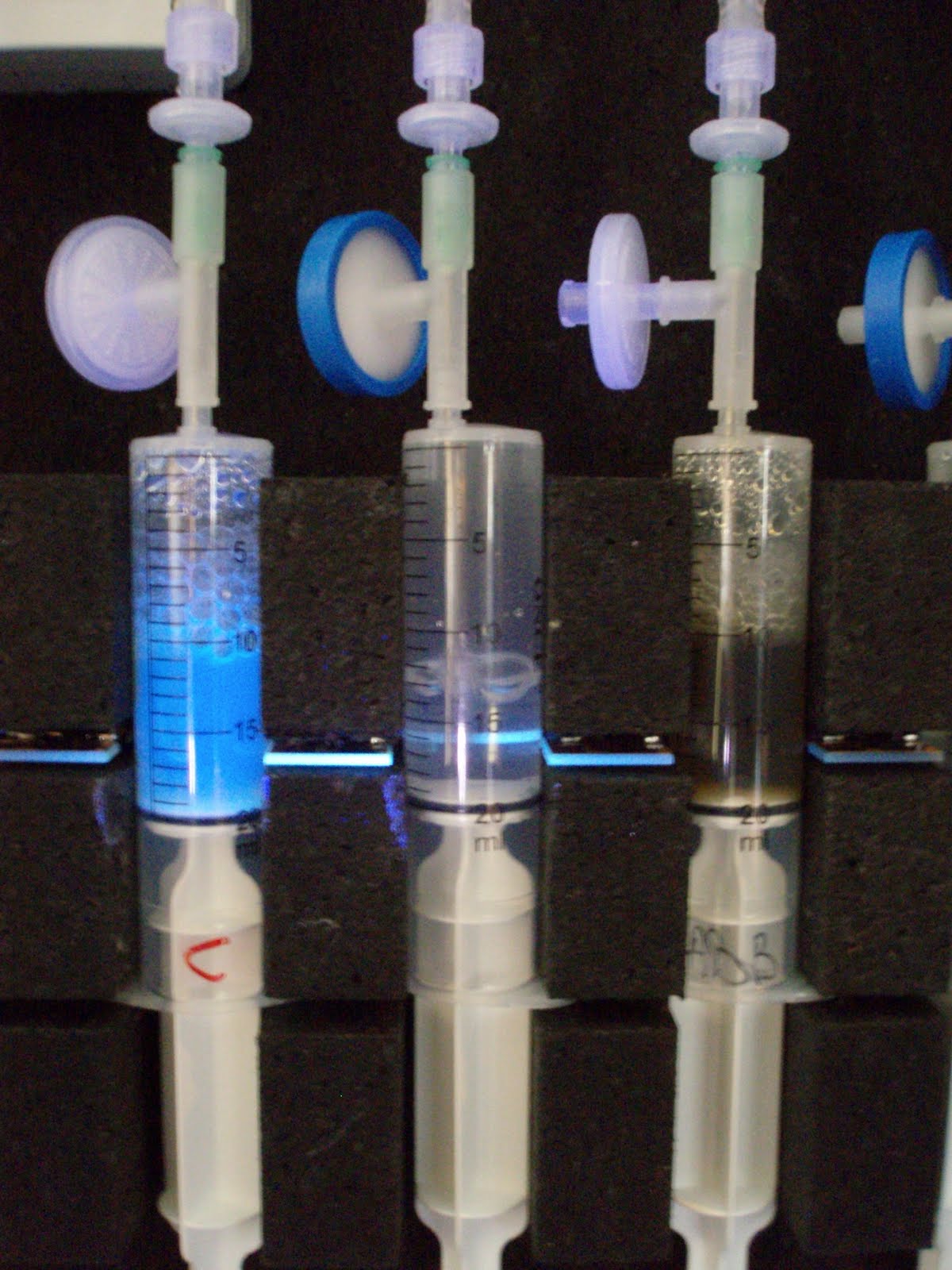
Novel PMEU water hygiene analyses, intended in the quantitative control of total coliforms, E.coli and enterococci, have been published in "Rakennustarkastuspäivät 2010" Conference, Kuopio, Finland at the end of March. This annual event is dedicated to professionals of building regulations and related administration and collected over 200 participants to the beutiful capital of Savo region, in the middle of Saimaa lake district.
SAMPLION Ltd. was exhibiting PMEU Spectrion and its water hygiene applications, now qualified by VTT, alongside Suomen Jätevesi Ltd. which is the major supplier of small-scale waste water purification systems in Finland.
The picture above demonstrates the combination of selective growth medium and MUG-based UV fluorescence confirmation of E.coli. Among the three PMEU syringes, only the one on the left, containing a culture of E.coli, indicates this fluorescence. This PMEU method is now approved by VTT, Technical Research Centre of Finland (VTT-S-01705-10) and it also follows the guidelines of international standardization (SFS-EN ISO 9308-3) to fulfill the needs of rapid, quantitative control of hygiene indicator bacteria.
Tuesday, January 12, 2010
SAMPLION Ltd. in Finnish Medicine Congress, Helsinki, January 11.-14.2010

PMEU Spectrion is one of the microbiological analyse devices manufactured by SAMPLION Ltd. It represents a modification of the basic PMEU where the turbidity of the samples, correlating with the microbial growth inside the test syringes, will be automatically measured with LED detection.
Beside the PMEU Spectrion, results of some hospital projects were also presented in the form of a poster.
Sunday, December 13, 2009
Fast detection of bacterial growth by using Portable Microbe Enrichment Unit (PMEU) and ChemPro100i® Gas Sensor.
The series of scientific articles, based on the microbiological research beneficing PMEU methods, continues. The new model of PMEU, "Scentrion", measures the gaseous metabolites, derived from the microbial activity in the sample syringes, and gives therefore the fastest indication of very low contamination levels in only 2..3 hours. PMEU Scentrion is already applied in a Finnish hospital laboratory. It is one of the new PMEU innovations, presented in a short R&D period in 2009 (another is PMEU "Spectrion" where the detection of the microbial growth bases on automatic turbidity measurement - more about it in future posts of this blog).
A short notification of this article follows below (to have more detailled view into the method and results derived with it, please refer the original article, published in June 2009 by Pathophysiology):
"E. Hakalehto, J. Pesola, A. Heitto, B. Bhanj Deo, K. Rissanen, U. Sankilampi, T. Humppi, H. Paakkanen.
Fast Detection of Bacterial Growth by using Portable Microbe Enrichment Unit (PMEU) and ChemPro100i® Gas Sensor.
Pathophysiology 16:1 (2009) 57-62.
PMEU Scentrion gives results in a few hours from the cultures, starting from only single cells per ml to a few hundreds of cells per ml. It is therefore a clear improvement to even PCR methods, which normally require an overnight pre-enrichment to be practically sensitive enough."
A short notification of this article follows below (to have more detailled view into the method and results derived with it, please refer the original article, published in June 2009 by Pathophysiology):
"E. Hakalehto, J. Pesola, A. Heitto, B. Bhanj Deo, K. Rissanen, U. Sankilampi, T. Humppi, H. Paakkanen.
Fast Detection of Bacterial Growth by using Portable Microbe Enrichment Unit (PMEU) and ChemPro100i® Gas Sensor.
Pathophysiology 16:1 (2009) 57-62.
PMEU Scentrion gives results in a few hours from the cultures, starting from only single cells per ml to a few hundreds of cells per ml. It is therefore a clear improvement to even PCR methods, which normally require an overnight pre-enrichment to be practically sensitive enough."
Friday, July 17, 2009
Enhanced enrichment and detection of thermotolerant Campylobacter species from water using the Portable Microbe Enrichment Unit and real-time PCR
Tarja Pitkänen, Juliane Bräcker, Ilkka T. Miettinen, Anneli Heitto, Jouni Pesola, and Elias Hakalehto
Can. J. Microbiol. 55(7): 849–858 (2009):
Abstract: An enhanced enrichment using the Portable Microbe Enrichment Unit (PMEU) with the microaerobic bubbling of broths was applied for the detection of thermotolerant Campylobacter species from water. This PMEU enrichment was compared with the conventional static enrichment of the international standard ISO 17995:2005. In addition, Campylobacter detection after enrichment using a real-time PCR detection was compared with colony counts. The tests with stressed Campylobacter jejuni cells in drinking water indicated that the PMEU enrichment yielded a significantly higher number of Campylobacter cells in the Bolton broth compared with the conventional static incubation. Application of the real-time PCR technique shortened the Campylobacter detection time. This combination of method modifications can be used for Campylobacter detection from water and adds methodological repertoire for the rapid survey and management of waterborne outbreaks.
Key words: Campylobacter, enrichment, Portable Microbe Enrichment Unit, real-time PCR, water.
Can. J. Microbiol. 55(7): 849–858 (2009):
Abstract: An enhanced enrichment using the Portable Microbe Enrichment Unit (PMEU) with the microaerobic bubbling of broths was applied for the detection of thermotolerant Campylobacter species from water. This PMEU enrichment was compared with the conventional static enrichment of the international standard ISO 17995:2005. In addition, Campylobacter detection after enrichment using a real-time PCR detection was compared with colony counts. The tests with stressed Campylobacter jejuni cells in drinking water indicated that the PMEU enrichment yielded a significantly higher number of Campylobacter cells in the Bolton broth compared with the conventional static incubation. Application of the real-time PCR technique shortened the Campylobacter detection time. This combination of method modifications can be used for Campylobacter detection from water and adds methodological repertoire for the rapid survey and management of waterborne outbreaks.
Key words: Campylobacter, enrichment, Portable Microbe Enrichment Unit, real-time PCR, water.
Sunday, July 12, 2009
Marketing of PMEU unit is starting in this summer.
PMEU (Portable Microbiological Enrichment Unit) was developed by Dr. Elias Hakalehto for research purposes on 90's. A novel company called SAMPLION Ltd., grounded in May 2009, starts to deliver PMEU applications for different areas of microbiology.
Main features of PMEU enrichment, assay and testing procedures are its capability to enhance the growth of target microbes, its sensitivity and the challenge it serves when simulations of real target environments are needed. These features have already been proven in several research projects, derived eg. in hospitals, environmental laboratories and paper industry institutes.
We shall present these applications and refer our scientific articles, based on clinical, environmental, biotechnical and paper industry research projects, in this blog. All writers are experienced PMEU users, having long careers in microbiological research.
Main features of PMEU enrichment, assay and testing procedures are its capability to enhance the growth of target microbes, its sensitivity and the challenge it serves when simulations of real target environments are needed. These features have already been proven in several research projects, derived eg. in hospitals, environmental laboratories and paper industry institutes.
We shall present these applications and refer our scientific articles, based on clinical, environmental, biotechnical and paper industry research projects, in this blog. All writers are experienced PMEU users, having long careers in microbiological research.
Subscribe to:
Posts (Atom)

